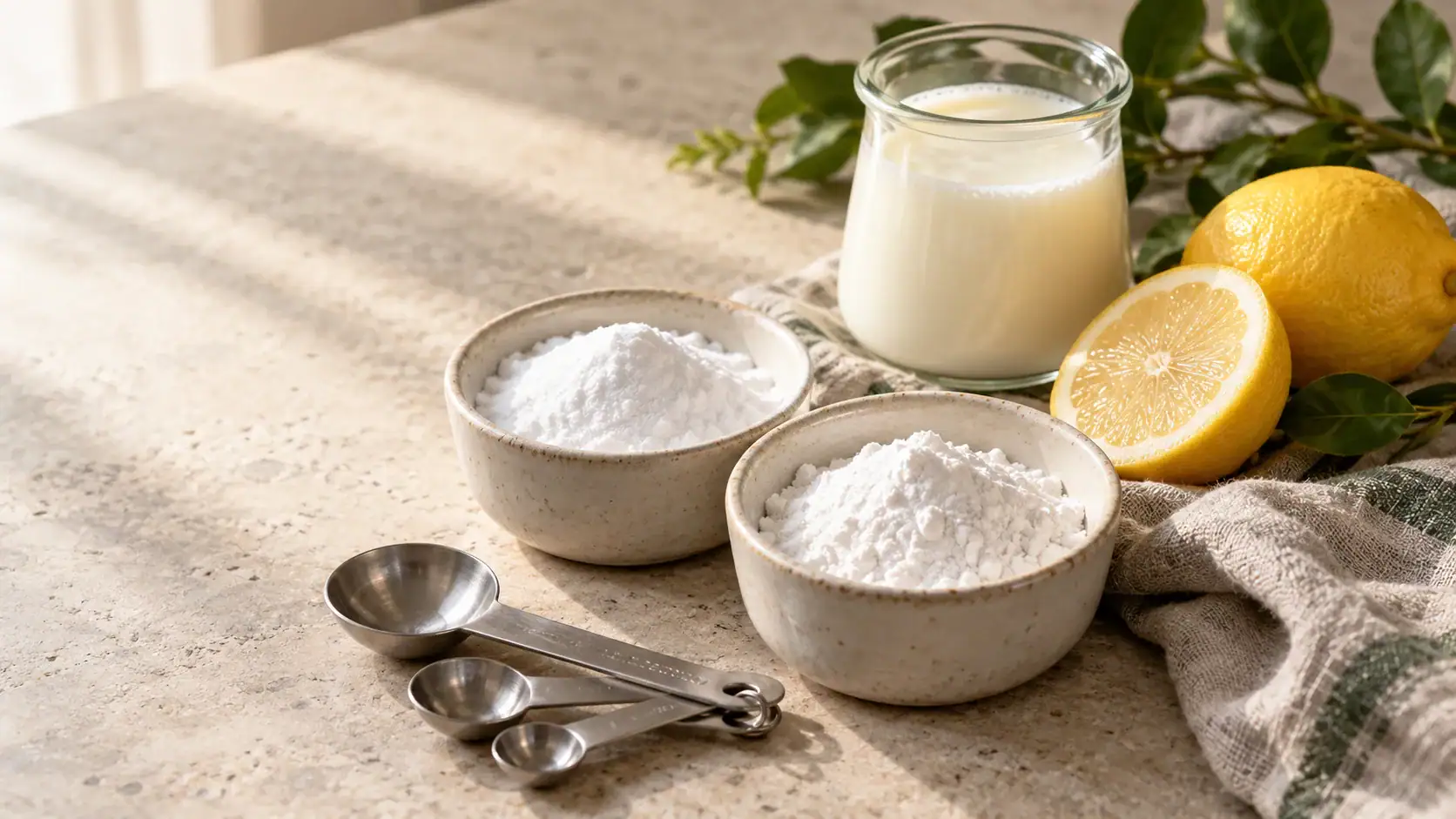
AI-generated illustrative ingredient image; not a photographed cooking test.
Baking soda and baking powder can look almost identical in a measuring spoon, but they do different jobs in a recipe. Baking soda reacts with an acidic ingredient when moisture is present. Baking powder already contains an acid component, so it does not need a separate acidic ingredient just to start working. Both can help a batter or dough rise. The useful question is how each one fits the whole recipe.
What baking soda does
Baking soda is sodium bicarbonate, an alkaline ingredient. When it meets acid in a moist mixture, the reaction releases carbon dioxide. Those gas bubbles contribute to lift. Yoghurt, buttermilk and lemon juice are familiar examples of acidic ingredients that can take part in this reaction. [1, 2]
This is why a spoonful of soda is not a free-standing solution for every flat cake. The amount of available acid matters. Adding more soda does not automatically give you more useful rise, and too much can leave an unpleasant taste. Measure what the recipe specifies rather than adding an extra pinch for luck. [2]
What baking powder does
Baking powder packages the alkaline and acidic components together. It contains bicarbonate and dry acid ingredients; the exact formulation can vary. A typical double-acting powder reacts when it becomes wet and again as it heats. This helps explain why a recipe can use baking powder without calling for lemon juice or yoghurt. [1, 2]
Double-acting does not mean you should double the quantity. It describes how the powder reacts. Read the container and the recipe carefully, especially when the names look similar on your shelf. A measured teaspoon of one powder is not automatically equivalent to a measured teaspoon of the other.
Why a recipe might need both
A recipe may need baking soda to neutralise some acidity and baking powder to supply additional leavening. Their roles overlap, but the combination can be intentional. Seeing both on an ingredient list is not a reason to remove one. Follow the amounts together unless the recipe author gives a tested alternative. [1]
Acidity also affects more than lift. A change in pH can influence browning, which is one reason changing a leavener can change the finished bake in ways beyond its height. King Arthur’s explanation of pretzel browning shows how an alkaline treatment encourages deeper colour. That is an example of the principle, not a reason to add extra soda to another recipe. [3]
Why the other ingredients matter
Cocoa offers a useful example. Natural cocoa is acidic, while Dutch-process cocoa has been treated to reduce its acidity. Switching between them can therefore change how a recipe’s baking soda behaves, as well as the colour and flavour. Look for the cocoa type the recipe names before assuming any cocoa powder will behave the same way. [4]
The same reading habit helps with the rest of the recipe: check the specified ingredients before judging the leavener in isolation. The presence of something acidic is a clue to the chemistry, not a universal instruction to choose soda. A working recipe balances several ingredients and processes.
Does this apply to bread
Some breads use baking soda or baking powder; others rely on yeast, and some get lift from other mechanisms. Quick breads can use chemical leaveners to generate gas without the yeast fermentation used in many traditional bread doughs. These are different approaches, so the word “bread” alone does not tell you which raising agent to use. [5]
For a yeast-based example, see MyWayToCook’s homemade pita bread recipe. Its ingredient list includes yeast, and its method gives the dough time to rise. Read it as a separate bread method rather than a recipe for replacing yeast with either white powder. [6]
What to check before a swap
Start with three checks: the exact name on the packet, the amount in the recipe, and whether the author provides a tested substitution. If the required ingredient is missing, choose a recipe written for what you have or follow recipe-specific substitution guidance. A straight one-for-one switch can upset the balance. [1, 2]
The simple reminder is useful: soda works with recipe acid; powder brings its own acid component. Keep that distinction in mind, then let the full recipe guide the decision. It is a small label check that is worth doing before the ingredients go into the bowl.
MyWayToCook homemade pita bread recipe
Sources
- King Arthur Baking — What’s the difference between baking soda and baking powder?
- University of Illinois Extension — Baking soda vs. baking powder, Jenna Smith, 6 December 2024
- King Arthur Baking — The science behind golden brown bread and extra-crispy croissants
- King Arthur Baking — Dutch-process vs. natural cocoa
- King Arthur Baking — How to make bread without yeast
- MyWayToCook — Homemade pita bread recipe