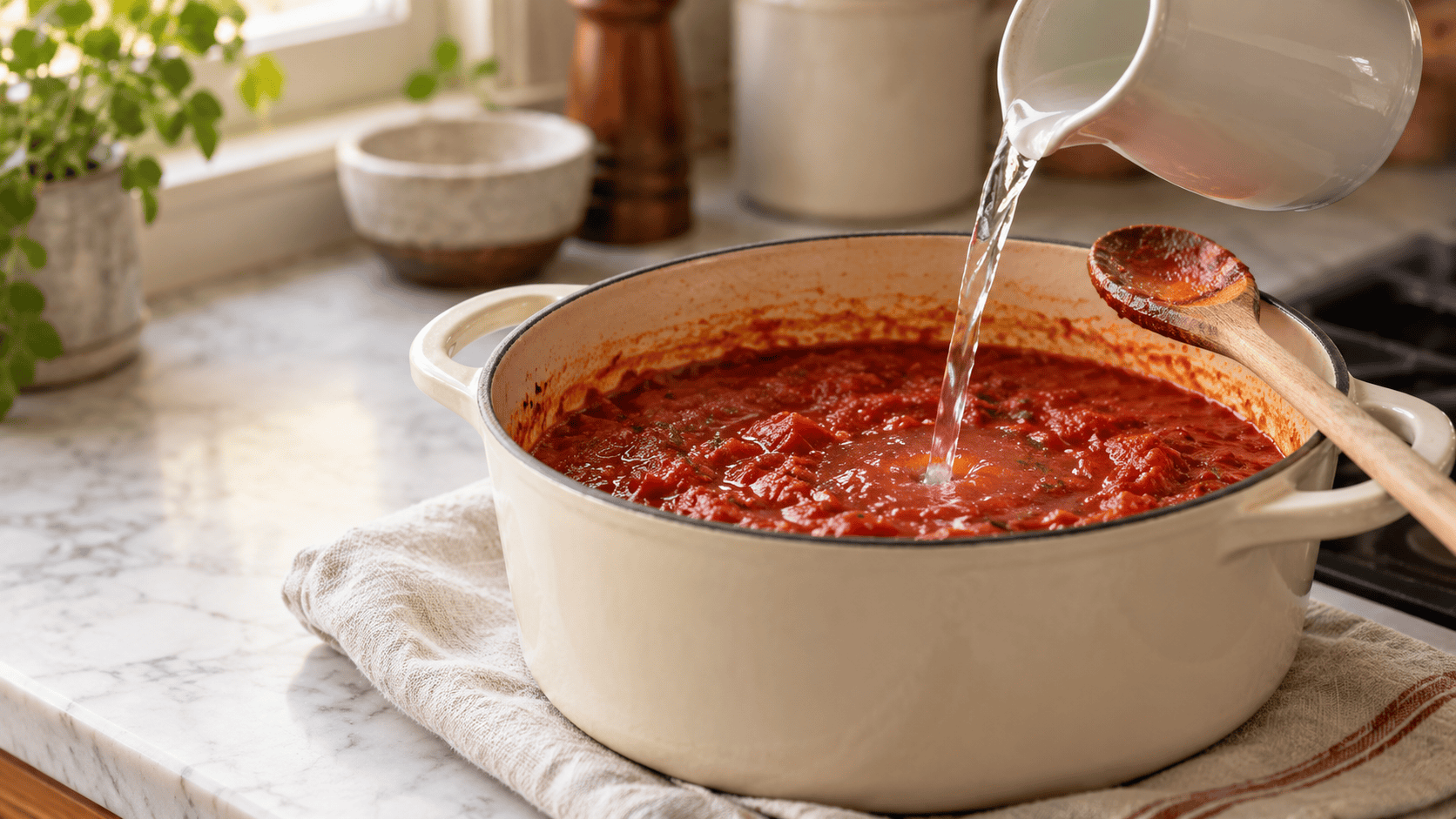
To fix a sauce that is too salty, gradually add a suitable unsalted liquid or an unsalted version of the sauce base, stir well, and taste again. Once the seasoning is comfortable, check the thickness. A sauce that has become thin may need a little thickener.
The important part is choosing an addition that belongs in the sauce. A splash of water might suit a gravy; more of the original base may be a better choice for a sauce whose flavor you want to preserve. Work slowly so you can judge each change before making the next one.
Start with dilution
Cookery writer Felicity Cloake recommends diluting an oversalted sauce with a non-salted liquid, then restoring its consistency with a roux or starch if needed. Water and cream are among her examples. Source: Completely Perfect, quick fixes, PDF page 29
Dilution spreads the existing salt through a larger amount of sauce. The salt has not disappeared, and the total salt in the pan has not fallen simply because you added water. You have changed how concentrated it is.
Think about the sauce before reaching for an ingredient. What is its main liquid? Is it already thin? Does it only taste a little too salty, or would you struggle to eat a spoonful? Those answers help you decide whether a small adjustment is worth trying or whether you need a fresh, unsalted base.
A careful four-step rescue
1. Pause and assess
Stop reducing the sauce while you decide what to add. Stir thoroughly, then let a small spoonful cool enough to taste comfortably. Put any salt or salty seasoning aside for now. Have a clean spoon, a small bowl, and your chosen liquid ready.
2. Try a small portion first
If you are unsure about an addition, transfer a little sauce to a bowl and try it there. This gives you a chance to notice a change in color, richness, or flavor before committing the whole pan. A successful tasting sample is useful guidance, rather than a promise that one fixed ratio will suit every sauce.
3. Make one change at a time
Add your chosen unsalted liquid or base gradually, mixing it through completely. Taste again before adding more. Avoid changing the sweetness, acidity, thickness, and seasoning all at once; it becomes much harder to tell which adjustment helped.
4. Check the finished result
When the saltiness is comfortable, assess the texture and the rest of the flavor. Does it still taste like the sauce you intended? Does it coat the food as you want? Stop making additions when it works. You do not have to use everything you set out on the counter.
Choose an addition that fits
For a gravy or a simple simmered sauce, water is a straightforward starting point. If choosing stock, check the label and use an unsalted option; ordinary stock, bouillon, and seasoned mixes can bring more salt into the pan.
For a cream-based sauce, a little more of the cream already used in the recipe may fit better. Test it first: it will also change the richness. Keep the original recipe’s heating instructions in mind.
For a thick sauce, consider preparing more of its base without the added salt or salty seasonings. Cook that separately as the recipe requires, then combine gradually. This applies food-science writer Jeff Potter’s advice to dilute excess salt by increasing the other ingredients. Source: Cooking for Geeks, second edition, page 65
Packaged ingredients deserve a second look. MyWayToCook’s vegetarian Japanese curry uses curry roux. When adjusting a sauce like this, check the roux’s ingredients before adding more of it as a thickener.
Restore thickness without boiling away the fix
Reducing a sauce means losing water. The dissolved salt remains as water evaporates, so cooking away the liquid you just added can concentrate it again. The Exploratorium demonstrates this underlying principle in its salt-solution activity. Source: Exploratorium Science of Cooking
If a starch-thickened finish suits the sauce, mix a little cornstarch with cold water in a separate bowl until smooth. Re-stir it immediately before use, then add gradually while stirring the heated sauce. Allow it to thicken before deciding whether it needs more. Follow the starch package or a trusted sauce recipe for cooking directions.
Namiko Hirasawa Chen’s slurry guide emphasizes cool mixing water, gradual additions, and checking the consistency as you go. It also notes that the sauce can continue thickening off the heat. Source: Just One Cookbook's slurry guide
Do not apply this hot-sauce method automatically to cold dressings, mayonnaise, or other sauces with a different preparation method.
When a small adjustment is not enough
Sometimes the amount of extra liquid needed leaves too little of the original flavor. Pause before spending more ingredients on the rescue. You may prefer to make a fresh unsalted base and mix in only as much of the salty sauce as tastes good, or simply start again.
Dilution can also produce more sauce than you wanted. Check the pan’s capacity and the practical size of the batch before continuing. Saving every spoonful is not always the most useful outcome.
How to avoid the same problem next time
Taste before adding a seasoning ingredient, and again after it is mixed through. At the Institute of Culinary Education, chef-instructors teach seasoning through gradual additions and repeated tasting. Source: ICE on learning to season
Read the whole ingredient list before cooking so you know which additions bring salt. Keep your final seasoning check for the finished consistency, and make a note if the brand or quantity you used needs adjusting next time.
For another cooking project, browse the MyWayToCook recipe collection or pair a suitable curry with stovetop naan.
Frequently asked questions
Can I just add water?
For many simmered sauces, yes. Start gradually and check both flavor and thickness. If the sauce loses its character, more of an unsalted base may be a better fit.
Will sugar or lemon juice remove the salt?
No. Changes in sweetness or sourness can change how flavors are perceived; they do not take the salt out. Potter distinguishes masking slight oversalting from diluting it. This guide uses dilution as the main correction.
Should I add a potato to soak up the salt?
This guide does not rely on that trick. Cloake recommends dilution followed by rethickening instead. It is a more direct method to assess as you work.
How much liquid should I add?
There is no single amount for every sauce. The starting saltiness, batch size, and original consistency all differ. Begin with a small addition, stir well, and taste before repeating.